
Only buses will stop here – Not your time … So Keep walking towards your goal


Profile :
The opinion expressed here or re- blogged are my personal opinion and views and has no relation to any organization , group or people.
Public Facebook Profile:
Only buses will stop here – Not your time … So Keep walking towards your goal

The media constellation has become increasingly fractured. The Web produced the initial fissure, but mobile created new cracks in the landscape. Today, no single medium earns more than 45% of our media consumption.
How can you solve this problem? Social media offers a solution.

Social networks like Facebook and Twitter are daily destinations for millions of consumers. Increasingly, their ad products offer targeting according to specific demographics, social connections, interests, and habits.
In a new report from BI Intelligence, we analyze the state of social media advertising and where it is heading, offering a comprehensive guide and examination of the advertising ecosystems on Facebook and Twitter, offer a primer on Tumblr as an emerging ad medium, and detail how mobile is an important part of this story as mobile-friendly as native ad formats fuel growth in the market.
Access The Full Report And Data By Signing Up For A Free Trial Today >>
Here’s an overview of some major players in the mobile advertising ecosystem:
The lure of social media advertising is massive: As brands look across a fractured media landscape, social networks offer them an interesting proposition. Social networks have scale – enormous user bases and deep databases. They have high engagement – Americans were spending an average of 12 hours per month on social networks as of July 2012, with 18-24 year olds averaging 20 hours. And potentially, social media gives brands offer a uniquely captive audience for their content.
Guaranteed placement is getting advertisers to pay up: Brands are paying to get their content or copy in front of a quantifiable audience, an increasingly rare feat in an era of scattered consumer attention. This desire for guaranteed attention also helps to explain social media’s move away from traditional display ads — like Facebook’s right-rail ads — and toward so-called native ads that surface in a user’s stream, either as a tweet or a Facebook post. A consensus seems to be forming around in-stream advertising as the most promising social advertising format.
Social media advertising is set to explode: Social media advertising is a young market and so far, it only represents 1% to 10% of ad budgets for a wide majority of advertisers. There’s significant opportunity for that share to grow. BIA/Kelsey recently came out with a study that offers one view – forecasting $11 billion of social ad spend in 2017, up from $4.7 billion last year. That estimate is large – but still seems pessimistic, because…
Increased mobile usage will be a huge growth driver: The BIA/Kelsey prediction calls for mobile to account for only $2.2 billion of that in 2017 – a 20% market share. This could easily be surpassed. Both Twitter and Facebook have passed the 50% mobile usage mark and, given the continued growth of mobile devices, it will only rise. Mobile accounted for 11% of Facebook’s ad revenue last year even though it didn’t release mobile ads until the tail end of the second quarter. By the fourth quarter, it was up to 23%. And now, Twitter is reporting that its mobile ad revenue now regularly outpaces its desktop ad revenue. Social media advertising is therefore uniquely positioned to grab an increasing share of the fast growing mobile advertising market.
Read more: http://www.businessinsider.com/state-of-social-media-advertising-2013-5#ixzz2Vxzyw3RB

Temple is a 6 letter word
Church is a 6 letter word
Mosque is also a 6 letter word
Geeta is a 5 letter word
Bible is a 5 letter word
Quran is also a 5 letter word
I know “people” who pat my back are the ones who look for soft spot to plant the knife !
Revealed: The NSA’s powerful tool for cataloguing global surveillance data – including figures on US collection
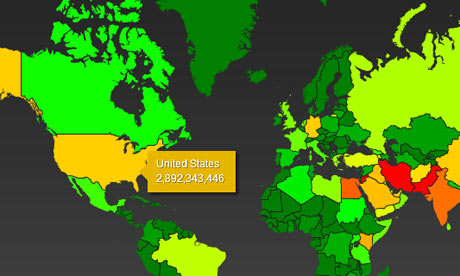
The color scheme ranges from green (least subjected to surveillance) through yellow and orange to red (most surveillance). Note the ‘2007’ date in the image relates to the document from which the interactive map derives its top secret classification, not to the map itself.
(Disclaimer : Map and data as published on http://www.guardian.co.uk/world/2013/jun/08/nsa-boundless-informant-global-datamining#
The National Security Agency has developed a powerful tool for recording and analysing where its intelligence comes from, raising questions about its repeated assurances to Congress that it cannot keep track of all the surveillance it performs on American communications.
The Guardian has acquired top-secret documents about the NSA datamining tool, called Boundless Informant, that details and even maps by country the voluminous amount of information it collects from computer and telephone networks.
The focus of the internal NSA tool is on counting and categorizing the records of communications, known as metadata, rather than the content of an email or instant message.
The Boundless Informant documents show the agency collecting almost 3 billion pieces of intelligence from US computer networks over a 30-day period ending in March 2013. One document says it is designed to give NSA officials answers to questions like, “What type of coverage do we have on country X” in “near real-time by asking the SIGINT [signals intelligence] infrastructure.”
An NSA factsheet about the program, acquired by the Guardian, says: “The tool allows users to select a country on a map and view the metadata volume and select details about the collections against that country.”
Under the heading “Sample use cases”, the factsheet also states the tool shows information including: “How many records (and what type) are collected against a particular country.”
A snapshot of the Boundless Informant data, contained in a top secret NSA “global heat map” seen by the Guardian, shows that in March 2013 the agency collected 97bn pieces of intelligence from computer networks worldwide.
boundless heatmap The heat map reveals how much data is being collected from around the world. Note the ‘2007’ date in the image relates to the document from which the interactive map derives its top secret classification, not to the map itself.

Iran was the country where the largest amount of intelligence was gathered, with more than 14bn reports in that period, followed by 13.5bn from Pakistan. Jordan, one of America’s closest Arab allies, came third with 12.7bn, Egypt fourth with 7.6bn and India fifth with 6.3bn.
The heatmap gives each nation a color code based on how extensively it is subjected to NSA surveillance. The color scheme ranges from green (least subjected to surveillance) through yellow and orange to red (most surveillance).
The disclosure of the internal Boundless Informant system comes amid a struggle between the NSA and its overseers in the Senate over whether it can track the intelligence it collects on American communications. The NSA’s position is that it is not technologically feasible to do so.
At a hearing of the Senate intelligence committee In March this year, Democratic senator Ron Wyden asked James Clapper, the director of national intelligence: “Does the NSA collect any type of data at all on millions or hundreds of millions of Americans?”
“No sir,” replied Clapper.
Judith Emmel, an NSA spokeswoman, told the Guardian in a response to the latest disclosures: “NSA has consistently reported – including to Congress – that we do not have the ability to determine with certainty the identity or location of all communicants within a given communication. That remains the case.”
Other documents seen by the Guardian further demonstrate that the NSA does in fact break down its surveillance intercepts which could allow the agency to determine how many of them are from the US. The level of detail includes individual IP addresses.
IP address is not a perfect proxy for someone’s physical location but it is rather close, said Chris Soghoian, the principal technologist with the Speech Privacy and Technology Project of the American Civil Liberties Union. “If you don’t take steps to hide it, the IP address provided by your internet provider will certainly tell you what country, state and, typically, city you are in,” Soghoian said.
That approximation has implications for the ongoing oversight battle between the intelligence agencies and Congress.
On Friday, in his first public response to the Guardian’s disclosures this week on NSA surveillance, Barack Obama said that that congressional oversight was the American peoples’ best guarantee that they were not being spied on.
“These are the folks you all vote for as your representatives in Congress and they are being fully briefed on these programs,” he said. Obama also insisted that any surveillance was “very narrowly circumscribed”.
Senators have expressed their frustration at the NSA’s refusal to supply statistics. In a letter to NSA director General Keith Alexander in October last year, senator Wyden and his Democratic colleague on the Senate intelligence committee, Mark Udall, noted that “the intelligence community has stated repeatedly that it is not possible to provide even a rough estimate of how many American communications have been collected under the Fisa Amendments Act, and has even declined to estimate the scale of this collection.”
At a congressional hearing in March last year, Alexander denied point-blank that the agency had the figures on how many Americans had their electronic communications collected or reviewed. Asked if he had the capability to get them, Alexander said: “No. No. We do not have the technical insights in the United States.” He added that “nor do we do have the equipment in the United States to actually collect that kind of information”.
Soon after, the NSA, through the inspector general of the overall US intelligence community, told the senators that making such a determination would jeopardize US intelligence operations – and might itself violate Americans’ privacy.
“All that senator Udall and I are asking for is a ballpark estimate of how many Americans have been monitored under this law, and it is disappointing that the inspectors general cannot provide it,” Wyden told Wired magazine at the time.
The documents show that the team responsible for Boundless Informant assured its bosses that the tool is on track for upgrades.
The team will “accept user requests for additional functionality or enhancements,” according to the FAQ acquired by the Guardian. “Users are also allowed to vote on which functionality or enhancements are most important to them (as well as add comments). The BOUNDLESSINFORMANT team will periodically review all requests and triage according to level of effort (Easy, Medium, Hard) and mission impact (High, Medium, Low).”
Emmel, the NSA spokeswoman, told the Guardian: “Current technology simply does not permit us to positively identify all of the persons or locations associated with a given communication (for example, it may be possible to say with certainty that a communication traversed a particular path within the internet. It is harder to know the ultimate source or destination, or more particularly the identity of the person represented by the TO:, FROM: or CC: field of an e-mail address or the abstraction of an IP address).
“Thus, we apply rigorous training and technological advancements to combine both our automated and manual (human) processes to characterize communications – ensuring protection of the privacy rights of the American people. This is not just our judgment, but that of the relevant inspectors general, who have also reported this.”
She added: “The continued publication of these allegations about highly classified issues, and other information taken out of context, makes it impossible to conduct a reasonable discussion on the merits of these programs.”
As published on http://www.guardian.co.uk/world/2013/jun/08/nsa-boundless-informant-global-datamining#


There was considerable mouth-dropping from publications such as at initial reports this week that NSA programs are gathering both telephone records and information gleaned from large tech companies like Google and Microsoft. But as those reports have settled in, reactions have gotten more complex.
One intriguing line of thought came from David Simon, a Baltimore Sun crime reporter turned TV writer who created, among other projects, the acclaimed HBO show The Wire. Literally named after police surveillance tactics, The Wire largely exists as a critique of the failures of government institutions — especially the way the government investigates and responds to crime.
In on his own site, Simon argues that the sheer breadth of the information being collected by the NSA means that very little of it is actually being looked at; it’s being put into a database to be used later in ways that will more seriously raise privacy concerns and implicate policy.
“That is tens of billions of phone calls,” he argues, “and for the love of god, how many agents do you think the FBI has?”
Simon posits that what will determine whether these programs are illegal, unconstitutional, discriminatory or otherwise privacy-violating will be what happens to this data and what decisions are made about how to use it. If they abuse the information, he says, the problem will be the abuse, not the possession of the data, which is a horse both (1) out of the barn and (2) of a different color from targeted eavesdropping.
But for a lot of us, this certainly had the feeling of sharp, strange intrusiveness, and as is often the case, very real discomfort came out through semi-dark jokes like the ones NPR’s under the hashtag “#CallsTheNSAKnowsAbout.”
“I rarely answer my mother’s calls the first time she tries to reach me,” offered one reader. “Sometimes Grandma and I have long, uncomfortable pauses,” offered another. We envisioned the NSA reading our e-mails, looking at our status updates, and seeing that we haven’t called the dentist like we said we would.
This was it, in the popular imagination — some supercomputer of intrusive eyeballing come to life, a combination of Skynet and HAL 9000 and the guys on Law & Order who can improve the quality of a bank surveillance video until they can make out the logo on your underwear through your pants.
But would we really care? Would the growing number of people who willingly share so much of what they do on Twitter and Facebook and Foursquare be horrified that the government could, in theory, look at a database of their phone calls? If you spend your time posting, “Here’s a map showing where I am, a list of people I’m with, a description of what I’m doing, a picture out my window, a list of the companies I buy from, a list of political causes I support, three articles I just read, and my review of the movie I just saw and where I saw it,” what are the odds that the existence of a database saying your phone called this other phone for 4 minutes and 19 seconds will shock your conscience?
The way we live now, we use our data as a currency. Maybe we should, maybe we shouldn’t, but we do. In fact, any time you appear to be getting something for nothing, there is an excellent chance that you are paying in part with your personal information. Store loyalty cards give you discounts, which you get in return for overlooking or accepting that someone now has (or could have) a history of everything you’ve ever bought.
If the government assigned you a grocery card that tracked all your food purchases, it would seem like something out of a dystopian everybody-in-a-jumpsuit movie. But when your grocery store does it in return for a dollar off a bottle of salad dressing, that’s an absolutely everyday occurrence for many of us. Going through toll booths is much easier and faster if you have a device on your windshield that automatically charges your account as you drive through — of course, that means there’s a record of every time you drove through.
It’s a mistake to imagine that all of this is hidden from view; that consumers do all this not knowing they’re doing it. Many, many perfectly savvy people know very well that their information is being constantly accumulated by Verizon and Sprint, Google and Amazon and Apple and Netflix, as well as banks, stores, car dealerships, cable companies, doctors, and insurance companies. In fact, the growing problem of managing the sheer number of passwords we all have is caused by the number of entities that we know have information about us or belonging to us that we don’t want just anyone to be able to access.
Many of us do this not because we don’t know about it, but because there are benefits to it. Storing stuff in the cloud, to use just one example, is great for lots of reasons — you can access it from anywhere, you don’t have to store it, and you don’t have to worry about frying your hard drive (or burning up your file cabinet) and losing all your contacts (or all your work, or your books, or your music).
Of course, that means somebody else somewhere — actually a lot of somebodies, none of whom you’ve ever met, to the good faith and security practices of whom you are effectively entrusting yourself — could find out whenever they chose what books you bought, what’s in your email, what you listen to, what documents you’ve written, whom you talk to, and what organizations you contribute to. You just have to figure they won’t.
It’s an economy of often queasy trust that applies to private companies the same principle Simon is applying to the government: it’s probably not that big a deal, this thinking goes, that they have a massive motherlode of information, because they probably aren’t going to do anything with it, and if they do, that’s where the problem arises. That’s what most people believe about their email, for instance — sure, the email provider could read it, but probably nobody is going to bother. We assume that we will hide in the crowd, protected by its very size.
That’s true even though, on a regular basis, tales emerge of data being used in ways we haven’t thought of. A 2012 New York Times how Target set out to find a statistical, data-mining method of determining whether a woman was pregnant even if she did not want them to know. We know now that companies use data about the kinds of mundane things over which we’ve surrendered control in order to learn the kinds of private and personal things we still want to control.
And the reason this economy of queasy trust continues to flourish is that candidly, if you look at the numbers, it’s worked OK for most of us in practice. Most of the time, nobody calls you out for ordering a politically charged book for your Kindle or watching a dirty movie on demand, nobody confronts you about the comment you made in an email, and nobody comes to your house to ask why you bought wine while you’re pregnant. They could, but under ordinary circumstances, they don’t. If Target finds out you’re pregnant, all they really want to do is send you some coupons.
In a sense, we’re most comfortable with the profit motive as a reason to collect information. Amazon or Apple might know all about you, but the thing they’re most likely to do with that in practice, so far, is try to sell you stuff. That’s where the theory that the economy of trust in private companies can be extended to government hits one of several major snags.
We “trust” private companies to be reliably self-interested, and we don’t believe there’s a self-interested reason for them to read our email other than, worst-case scenario, to sell. And we further believe that their self-interest works to our advantage, because it wouldn’t be good business for people to find out that Google employees (for instance) were reading and passing around people’s embarrassing email on their lunch breaks. We don’t really trust them to limit their use of data in our best interests, but we might trust them to limit it in their own best interests. Part of our belief that they won’t do anything nefarious with the theoretically breathtaking information dump they have comes from the belief that it wouldn’t make them any money.
Government has no such transparent single motive, like profit, but a variety of motives, not all of which people are confident they know about. What you believe to be the motives of a particular administration or government agency depends on a complicated, often highly charged calculus of politics, policy, media consumption, and internalized constitutional theory that you may not have even verbalized but know in your gut. (The Fourth Amendment, really, has been developed by courts but is historically rooted in our collective sense of, “They can’t come in my house and do that when I didn’t do anything wrong.”)
Furthermore, government has powers that private companies don’t have. Target and Apple can’t arrest you, deport you, fine you, jail you, try you, charge you, tax you, or confiscate your stuff. What’s more, they are the final arbiters of nothing; you have potential recourse in court if they wrong you. Your only recourse, should the tentative trust you place in government prove misplaced, is … more government. Other branches, levels and segments of government. And, ultimately, your ability to vote for somebody else.
The problem is that if it proves to be true that because of these programs, the loose trust you place in Google is now extended to the government without your consent (or knowledge, until now), you don’t have a choice whether you want to be David Simon or The New York Times. You can’t opt out of that part. The benefits remain the same — your free email, your chat applications, your cloud storage — but the costs are different. Simon displays some actual relief that the government is using phone records and Internet information to potentially prevent crime; that’s a trade-off he won’t be alone in his willingness to make.
And even for those who aren’t relieved, they may be grudgingly willing to accept government access to data in return for whatever security advantages it might bring along with the mundane advantages of doing business with whatever tech company or cell phone provider is at issue. But not everybody is going to feel that way. Not everybody believes that they can predict what the government will do the way they think they can predict what Apple will do.
But what does not change with our willingness to make trade-offs is the constitutional question the Times raised of whether search, seizure and privacy provisions are being violated. Constitutional provisions, in part, exist to counteract our natural tendency to make bad deals in challenging historical moments, and to protect people who don’t want to make those deals from those who do. There is a value proposition in allowing both government (for security reasons) and business (for convenience reasons) to suck up data, but there was a value proposition in almost everything the constitution in its amended form was written to prevent.
There was a value proposition for at least some citizens in punishing people without trial, in denying universal suffrage, in punishing speech, and in slavery. That’s why those things are in the constitution, out of the easy reach of legislatures — we choose to outlaw them even if, in a specific context, a democratically elected government decided to vote for them. If all of this is constitutional — and it’s certainly not yet been found not to be — that’s not because it’s OK with enough of us, right now, considering what we get in return. That requires a different approach.
So our willingness to submit to surveillance in return for benefits may set our level of outrage or our level of willingness to do business with Google. It may dictate whether the ability to ensure privacy becomes a more treasured characteristic in a tech product and whether too much cooperation — if in fact these companies cooperated, which — is a mark against it. But the value proposition is not the end of the inquiry. The inquiry is going to be harder than that.
As published on http://www.npr.org/blogs/monkeysee/2013/06/09/189857722/when-your-data-is-your-currency-what-does-your-privacy-cost

Love begins with a smile, grows with a kiss, ends with a tear. When you were born, you were crying and everyone around you was smiling. Live your life so that when you die, you’re the one smiling and everyone around you is crying… Enjoy your weekend.
1. It hurts to love someone and not be loved in return. But what is more painful is to love someone and never find the courage to let that person know how you feel.
2. A sad thing in life is when you meet someone who means a lot to you, only to find out in the end that it was never meant to be and you just have to let go.
3. The best kind of friend is the kind you can sit on a porch swing with, never say a word, and then walk away feeling like it was the best conversation you’ve ever had.
4. It’s true that we don’t know what we’ve got until we lose it, but it’s also true that we don’t know what we’ve been missing until it arrives.
5. It takes only a minute to get a crush on someone, an hour to like someone, and a day to love someone-but it takes a lifetime to forget someone.
6. Don’t go for looks, they can deceive. Don’t go for wealth, even that fades away. Go for someone who makes you smile because it takes only a smile to make a dark day seem bright.
7. Dream what you want to dream, go where you want to go, be what you want to be. Because you have only one life and one chance to do all the things you want to do.
8. Always put yourself in the other’s shoes. If you feel that it hurts you, it probably hurts the person too.
9. A careless word may kindle strife. A cruel word may wreck a life. A timely word may level stress. But a loving word may heal and bless.
10. The happiest of people don’t necessarily have the best of everything they just make the most of everything that comes along their way.
11. Love begins with a smile, grows with a kiss, ends with a tear. When you were born, you were crying and everyone around you was smiling. Live your life so that when you die, you’re the one smiling and everyone around you is crying.
Imagine life as a game in which you are juggling some five balls in the air. They are Work, Family, Health, Friends and Spirit, and you’re keeping all of these in the air.
You will soon understand that work is a rubber ball. If you drop it, it will bounce back. But the four others – Family, Health, Friends and Spirit – are made of glass. If you drop one of these, it will be scuffed, nicked, damaged, even shattered. And it will never be the same.
Work efficiently during office hours and leave on time. Give proper time to your family and friends, and take a decent rest.
Value has a value only if its value is valued.
Mr. Brian G. Dyson was the chief executive officer (CEO) of Coca-Cola Company from 1986 to 1991.
Among the thousands of graduation addresses given each year, these stand out–mostly for the right reasons.
In 1994, I witnessed perhaps history’s most insane commencement addresses, at Wheaton College in Norton, Mass.
Connie Chung, then the anchor of CBS Evening News, offered a stream-of-consciousness recounting of a dream she’d had the night before–not exactly a Martin Luther King Jr.-style aspirational dream–a surreal story about using a portable toilet that turned out to be a zip-up garment bag. (I’m serious. There’s a video here.) Continue reading

 ::: Shailendra Nair :::
You must be logged in to post a comment.